
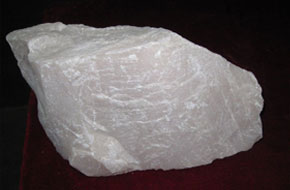
Talc is the softest rock in the world. Talc is hydrated magnesium silicate. It generally occurs in two morphologies, either macro- or microcrystalline. Talc can have slightly differing compositions subject to the associated minerals in the orebody, but all talcs exhibit to a lesser or greater extent the following unique features: softness, hydrophobicity, platyness and organophily. These properties can be further enhanced by careful and sometimes propriety processing and bring a number of specific benefits to a wide range of industries including paper, paints, plastics, ceramics, rubber, personal care and roofing.
Talc is a hydrated magnesium sheet silicate with the chemical formula Mg3 Si4 O10 (OH)2. Its elementary sheet is composed of a layer of magnesium-oxygen/hydroxyl octahedra, sandwiched between two layers of silicon-oxygen tetrahedra. The main or basal surfaces of this elementary sheet do not contain hydroxyl groups or active ions, which explains talc's hydrophobicity and inertness. Talc is practically insoluble in water and in weak acids and alkalis. It is neither explosive nor flammable. Although it has very little chemical reactivity, talc does have a marked affinity for certain organic chemicals, i.e. it is organophilic.
Above 900°C, talc progressively loses its hydroxyl groups and above 1050°C, it re-crystallises into different forms of enstatite (anhydrous magnesium silicate). Talc's melting point is at 1500°C.
There are hundreds of talc deposits of various sizes in activity throughout the world. Each talc deposit has its own features, its own geological signature. Talc can be white, grey, pink, blue, violet, green and even black. Talc is used in the manufacture of a myriad of everyday products.
Most talc deposits are open-pit mines. The waste rock covering the talc vein is removed using giant shovels.
The exposed talc is then extracted using shovels. Even at this early stage, the different ore types are sorted as they are extracted from the seam
Sorting the different talc ores according to their talc content and brightness is a key phase of the production process. Techniques include hand sorting, state-of-the-art laser and image analysis technology or flotation.
To obtain just the right particle size distribution curve and top cut for a given application, the techniques used include compressed air, steam and impact grinding. Median particle sizes can range from less than 1 micron to 15 microns, and top cuts from 6 microns to over 100 microns.
Certain grades of talc are treated, e.g. amine-coated talcs for fertilizers, silane-coated talcs for the rubber industry and cationic talcs for pitch control in papermaking. For the cosmetics and pharmaceuticals industries, talcs are heat-treated to decontaminate them.
Talc powder is delivered in bags, semi-bulk bags or in bulk. Increasingly, there is a demand for talc in pellet form or as a liquid (slurry).
We supply high quality Talc as per customer requirement and its application. Silent Features of Talc:
Talc is used in the manufacture of a myriad of everyday products including animal feed, automobiles, cables, sweets, ceramic tiles, chewing gum, cosmetics, fertilizers, foundry technology, olive oil processing, paint, paper, pharmaceuticals, plaster, plastics, printing inks, putties, refractories, roofing, sanitaryware, tyres and of course body powder.
With use of Talc material properties can be improved while the costs can be decreased. Therefore,Talc Is a indispensable material in the Production Process.
If you have any query or enquiry please submit your enquiry from here... Enquire Now!
Our representative shall get back to you shortly with the reply after consultation with the concerned departments. For any other query please contact us at contact@sunminerals.net